
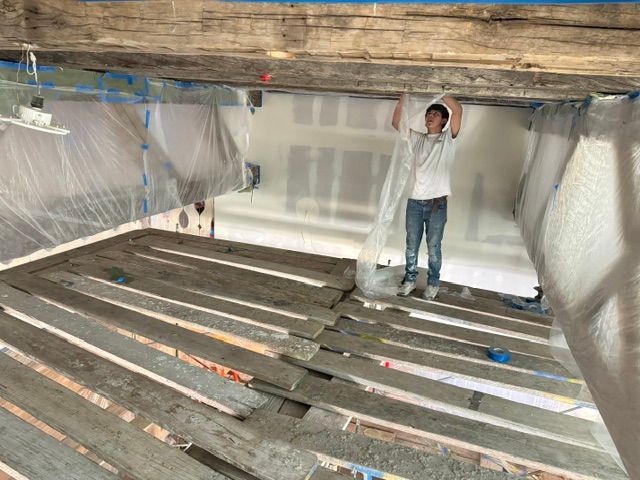
Damage Fixed Without Replacing Entire Walls
Drywall Repair & Ceiling Restoration in Sun Valley for holes, cracks, water damage, and texture-matching in residential and commercial spaces
Water stains spread across ceilings in irregular brown patterns after roof leaks or plumbing failures, and impact damage leaves holes surrounded by fractured gypsum that requires cutting back to solid material before patching can begin. These visible failures need repair that restores structural integrity and recreates the original surface appearance without leaving obvious patch marks or texture mismatches. Exclusive JD Stucco & Drywall LLC provides drywall patching and ceiling repairs throughout Sun Valley, addressing damage from furniture impacts, door handle collisions, failed fasteners, settling cracks, and moisture intrusion in both residential and commercial properties.
The repair process cuts damaged sections into clean geometric shapes, installs backing support where framing does not exist, fastens patch panels flush with surrounding surfaces, and finishes seams using the same taping sequence as new installations. Water damage repairs require confirming that moisture sources have been corrected and that affected framing and insulation have dried completely, since patching over active leaks or damp materials guarantees failure. Texture blending recreates knockdown, orange peel, or other patterns across repaired areas so that patches disappear once painted to match adjacent surfaces.
Request a damage assessment to identify whether repairs can proceed immediately or if underlying moisture or structural issues require attention before patching begins.

What Changes After Patch Work Finishes
Residential and commercial repairs both demand that patched areas become invisible under normal lighting, which requires matching not just texture but also the slight color and sheen variations that develop on aged drywall. Hole and crack repairs restore the wall's structural function so that it resists future impacts and supports mounted fixtures without flex or movement. In cases where damage covers large areas or involves multiple penetrations, patching individual spots becomes less practical than replacing entire panels, a decision based on damage density and whether attempting spot repairs would leave more seams than panel replacement.
You notice that repaired sections feel as solid as undamaged areas when pressed, with no detectable edges or ridges where patches meet original drywall. The texture pattern continues seamlessly across repairs without abrupt transitions or mismatched densities that catch light differently. Once primed and painted, patches blend completely into surrounding surfaces, though paint color matching sometimes requires painting entire walls rather than just patched spots to avoid sheen differences between new and aged paint. Ceiling repairs eliminate staining and restore flat planes without visible sag or unevenness that would indicate inadequate support or improper fastening.
Larger repairs may involve sister framing installation to provide solid backing, and some ceiling damage requires addressing failed fasteners across broader areas than the visible stain suggests. The repair reveals its quality not through what you see but through what you don't—no shadows at patch edges, no texture breaks, and no reminder that damage ever occurred.
Common Questions About This Service
Repair scenarios vary widely in complexity and cost, leading to frequent questions about what the work involves and how finished repairs will appear.
What distinguishes a simple patch from a repair requiring panel replacement?
Damage size and location determine repair approach, with holes smaller than six inches and located away from panel edges typically patchable using California or hot-patch methods, while larger damage or edge failures require cutting to the nearest stud and installing full panel sections with proper backing.
How do you match texture on ceilings with aged knockdown or popcorn patterns?
Texture matching involves recreating the original application method using similar material consistency and tools, then allowing the repair to dry completely before comparing it under the same lighting conditions present in the space, with adjustments made through additional applications if the first attempt shows visible differences.
Why does water damage sometimes require more extensive repair than the stain size suggests?
Water wicks through drywall and insulation beyond visible staining, often weakening paper facing and gypsum core in areas that appear undamaged, so proper repair cuts back to material that shows no discoloration or loss of structural integrity when tested.
When should ceilings be repaired versus replaced entirely?
Repair makes sense for isolated damage or localized failures, but widespread cracking, sagging between joists, or multiple water stains across large areas often indicate that replacement provides better long-term value than attempting numerous individual patches that may fail at different times.
How do drywall repairs perform in Sun Valley's dry climate compared to humid regions?
Low humidity accelerates joint compound drying, which can cause shrinkage cracking if repairs are rushed without adequate coats, but also means completed repairs cure thoroughly without the prolonged dampness that sometimes causes mold issues in coastal climates.
Exclusive JD Stucco & Drywall LLC examines damage extent before quoting repairs to confirm that all affected material gets addressed in a single visit rather than discovering additional problems mid-project. Set up an inspection to determine the most practical repair strategy for your specific damage pattern and budget considerations.