
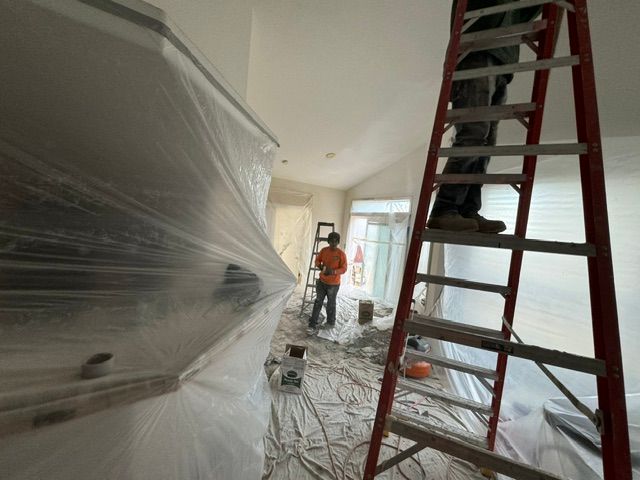
Interiors Finished for Immediate Occupancy
Residential & Commercial Drywall Installation in Sun Valley for new construction, tenant improvements, and remodeling projects requiring smooth walls and ceilings ready for paint
Drywall installation transforms framed spaces into finished rooms by covering insulation and utilities with gypsum panels that create paintable surfaces, a process that involves precise measurement, fastening, joint taping, and finish sanding across every wall and ceiling plane. Exclusive JD Stucco & Drywall LLC handles residential projects from single-room additions to whole-house builds and commercial build-outs including office suites, retail spaces, and medical facilities throughout Sun Valley. The work progresses from ceiling installation first, then walls, with panels oriented to minimize visible seams and positioned so that tapered edges meet at joints for easier finishing.
New drywall installation includes hanging panels with appropriate screw spacing for each framing type, applying paper or mesh tape over seams, and feathering joint compound across multiple coats until transitions become invisible under paint or texture. Drywall finishing levels range from basic taping suitable for texture coverage to smooth level-five finishes required under flat paint in critical lighting conditions. Texture matching happens after taping when existing adjacent spaces need seamless integration with new work.
Schedule an estimate review to determine panel thickness requirements, finish level specifications, and project timelines based on your construction schedule and occupancy deadlines.

What You Notice Once Drywall Finishing Completes
Proper installation means panels remain flat without fastener pops or bowed seams, and corner beads create crisp lines at inside and outside angles where walls meet or where soffits transition to ceilings. The taping process embeds reinforcement at every seam and conceals it through progressively wider compound applications that feather to zero thickness at edges, a technique that takes three to five coats depending on finish level. In remodeling projects, new drywall ties into existing surfaces through careful cutting and finishing that makes the addition invisible once painted.
You see smooth, uniform surfaces free from ridges, shadows, or visible seams when looking across walls at angles, which indicates proper feathering and adequate sanding between coats. Corners form straight lines without gaps, and ceiling-to-wall transitions appear seamless whether finished square or with cove details. The completed installation feels solid when tapped and shows no flex or movement at panel centers, which confirms adequate fastening to framing members. Commercial projects often include fire-rated drywall assemblies or impact-resistant panels in high-traffic corridors, specifications that affect both material selection and installation methods.
Finish sanding creates dust that requires containment measures during occupied remodels, and primer application happens after final sanding to seal the surface and reveal any remaining imperfections before paint. The time between hanging and painting typically spans five to seven days for standard projects, allowing each taping coat to dry completely before the next application.
What Property Owners Usually Ask
Installation details and finish quality standards often prompt questions about material choices, project duration, and how new work integrates with existing construction throughout Sun Valley buildings.
What determines whether half-inch or five-eighths-inch drywall gets installed?
Panel thickness depends on framing spacing and finish requirements, with five-eighths-inch panels required for fire-rated assemblies and recommended for ceilings on twenty-four-inch truss spacing to prevent sagging, while half-inch works for most wall applications on sixteen-inch centers.
How do you prevent fastener pops in Sun Valley's temperature swings?
Proper fastener depth that dimples the surface without breaking the paper face, combined with adequate framing attachment and appropriate screw spacing, prevents the expansion-contraction movement that causes fasteners to push through finished surfaces months after installation.
Why do some commercial projects require level-five finishes instead of standard taping?
Level-five finishing involves a skim coat of compound over the entire surface rather than just seams, which eliminates the subtle texture variations that become visible under flat paint in spaces with critical side lighting like retail displays or office glass walls.
When should moisture-resistant drywall be used instead of standard panels?
Moisture-resistant panels belong in areas with elevated humidity exposure like bathrooms, commercial kitchens, and laundry facilities, though they do not replace proper ventilation and are not suitable for direct water contact like shower enclosures, which require cement board or tile backer.
How does drywall finishing differ between residential and commercial build-outs?
Commercial work often involves larger uninterrupted wall spans, higher finish level requirements for professional appearance, and coordination with multiple trades for access panel placement and penetration scheduling, while residential projects typically include more detail work at architectural features and trim integration.
Exclusive JD Stucco & Drywall LLC coordinates material delivery and installation sequencing to keep your project moving without delays caused by missing components or access conflicts. Contact us to discuss your project scope and confirm that finish specifications match your intended paint and lighting plans.